Know what every machine is doing, and why

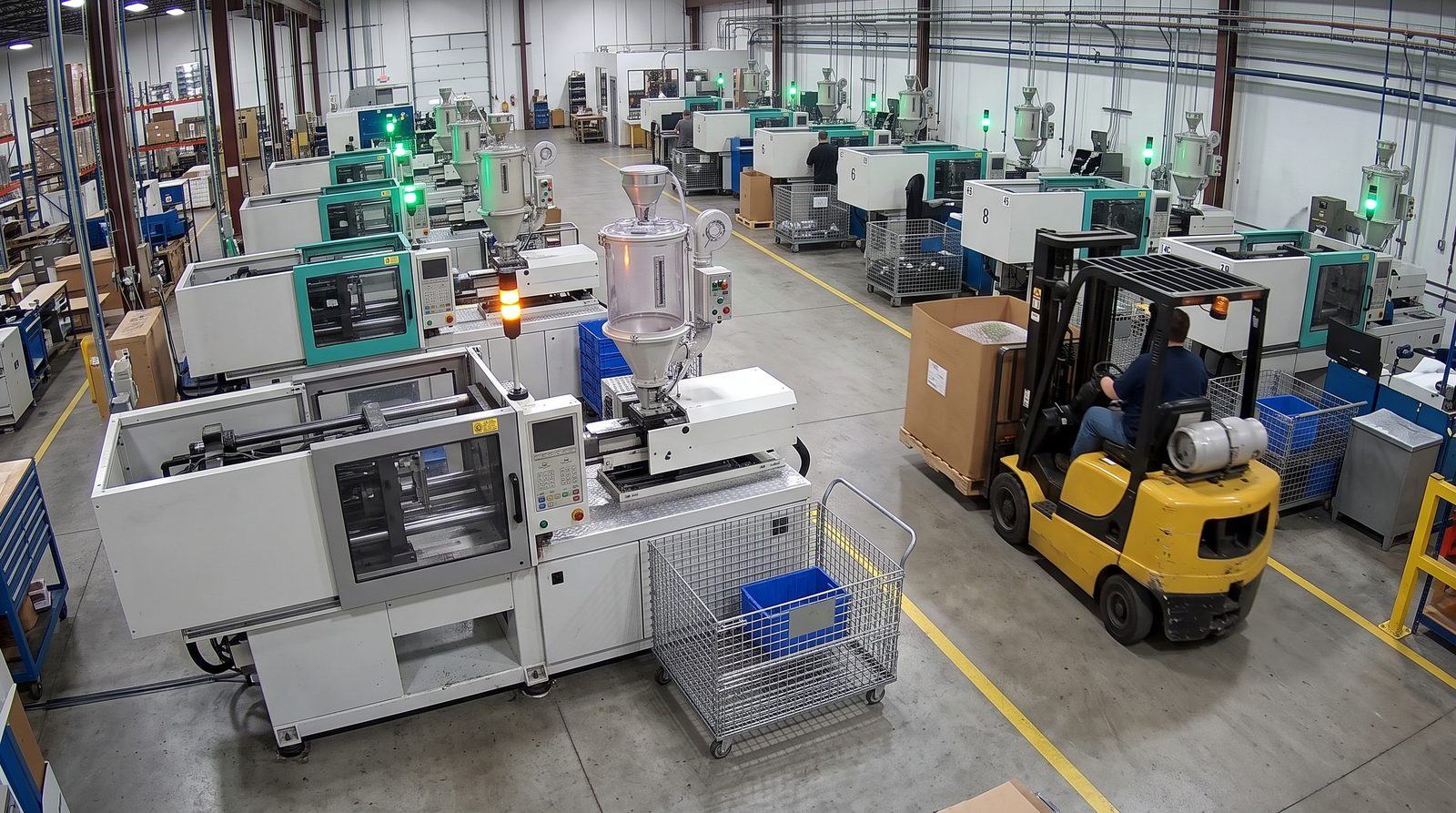
Agnify reads machine state from the cameras you already have: running, changeover, maintenance, waiting on material, down. Every stop gets its reason and the clip, and every part is counted and checked: OEE with the reason behind every loss, and no codes typed into a tablet.

Your existing cameras, plus one over a machine where it's needed Fuses PLC, stack-light and sensor signals where you have them Dashboards, alerts and an API alongside your MES or spreadsheets
Generated illustration · example data
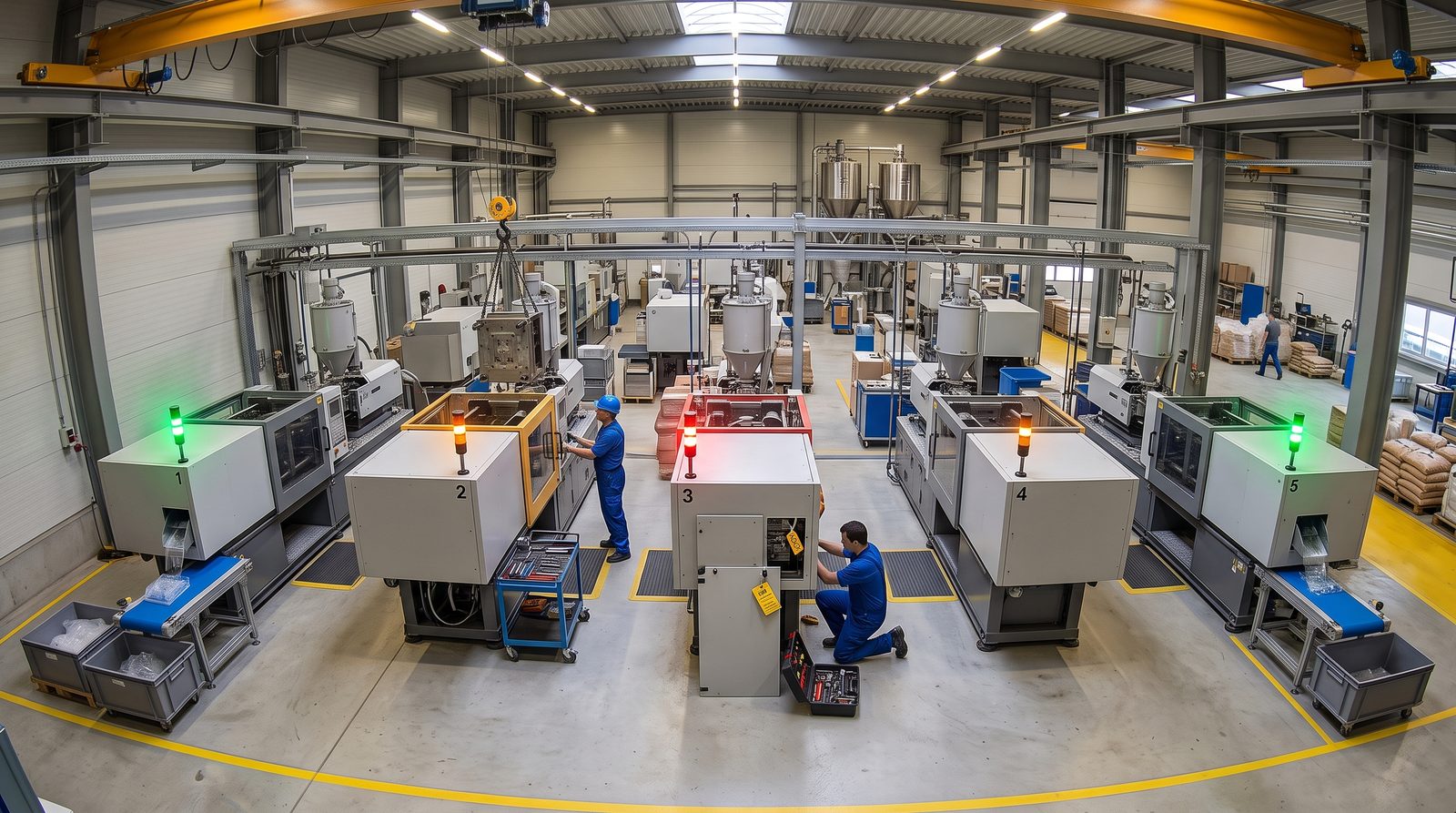
A camera view of five injection molding presses in a row: two running, one in a mold change with the mold on a crane, one under maintenance with a lockout tag, one idle with nobody at it
CAM-02 · Molding cell B · presses P1 to P510:35
P1Running42 s cycle
P2ChangeoverMold swap, 23 min
P3MaintenanceLockout on, 12 min
P4IdleNo operator, 6 min
P5Running41 s cycle
Downtime and bad parts cost more than most plants see

8.3%

Of planned production time lost to downtime in US discrete manufacturing, about $245B a year1

NIST, Annual Report on the U.S. Manufacturing Economy, 2024
$150K

Top-end cost of one hour of unplanned downtime for a small or mid-sized manufacturer2

Siemens, True Cost of Downtime 2024
85%

Of defective parts caught by trained inspectors, who also rejected 35% of good ones3

Sandia National Laboratories, 2015
70%

Of manufacturers still enter production data by hand4

NAM Manufacturing Leadership Council, 2024

OEE with the reason behind every loss

Availability from real stop times, performance from counted cycles, quality from rejects seen at the outfeed. Each of the six big losses gets its own time, cause and clip.

Example data. OEE = availability × performance × quality.

A sensor knows a machine stopped. The camera knows why.

Clamps, cycle sensors and stack lights show the same red for a tool change, an empty parts cart or nobody at the press. The reason waits for someone to enter it, often hours later. The camera sees the cause and saves the clip.

What a sensor records

P7 · 09:30 to 10:30 · example data

09:3010:0010:30
State
Stopped, 10:02 to 10:16
Duration
14 min
Reason
Not entered
Evidence
None
Terminal · P7 · qualify stop 10:02
MaterialChangeoverMaintenanceNo operatorOther

Someone picks a reason at the end of the shift. Often it's "Other".

Generated illustration · example boxes
A stopped injection molding press with an amber stack light, an empty parts cart beside it and nobody at the station, while a forklift brings a box of resin pellets down the aisle
CAM-05 · Molding cell B · P710:14
P7 · Waiting on material · 14 min · clip saved
  • Parts cart emptyNothing staged for the next run
  • No operator at the pressStation empty since 10:03
  • Resin delivery arrivingForklift at the press at 10:14
Reasons without the tabletClassified from the scene. Operators confirm instead of typing from memory.
Evidence, not a codeEvery stop, changeover and reject keeps its clip.
Small stops and slow cyclesThe performance losses nobody writes down, timestamped by machine and shift.
01 · AVAILABILITY AND PERFORMANCE

Every minute of the shift, in states that mean something on your floor

Every minute lands in an OEE loss you can act on. You choose each machine's states, and we build them from what the camera sees: the gate, the mold, the operator, the parts cart, the technician. Below, half a shift on the presses above.

Molding cell B · shift 1Press states from 06:00 to 10:35 · example data
Running 78%

Select a segment to see what the camera saw.

    Presses, lines, cells, ovens, cranes. If a person can see its state, so can the camera.

    Each machine type gets its own states and stop reasons.

    Which of your machines should we look at first?Send a few hours of footage. We'll show you its states and OEE losses.

    Book a free feasibility study
    02 · SETUP AND ADJUSTMENT LOSS

    The minutes inside every changeover, step by step

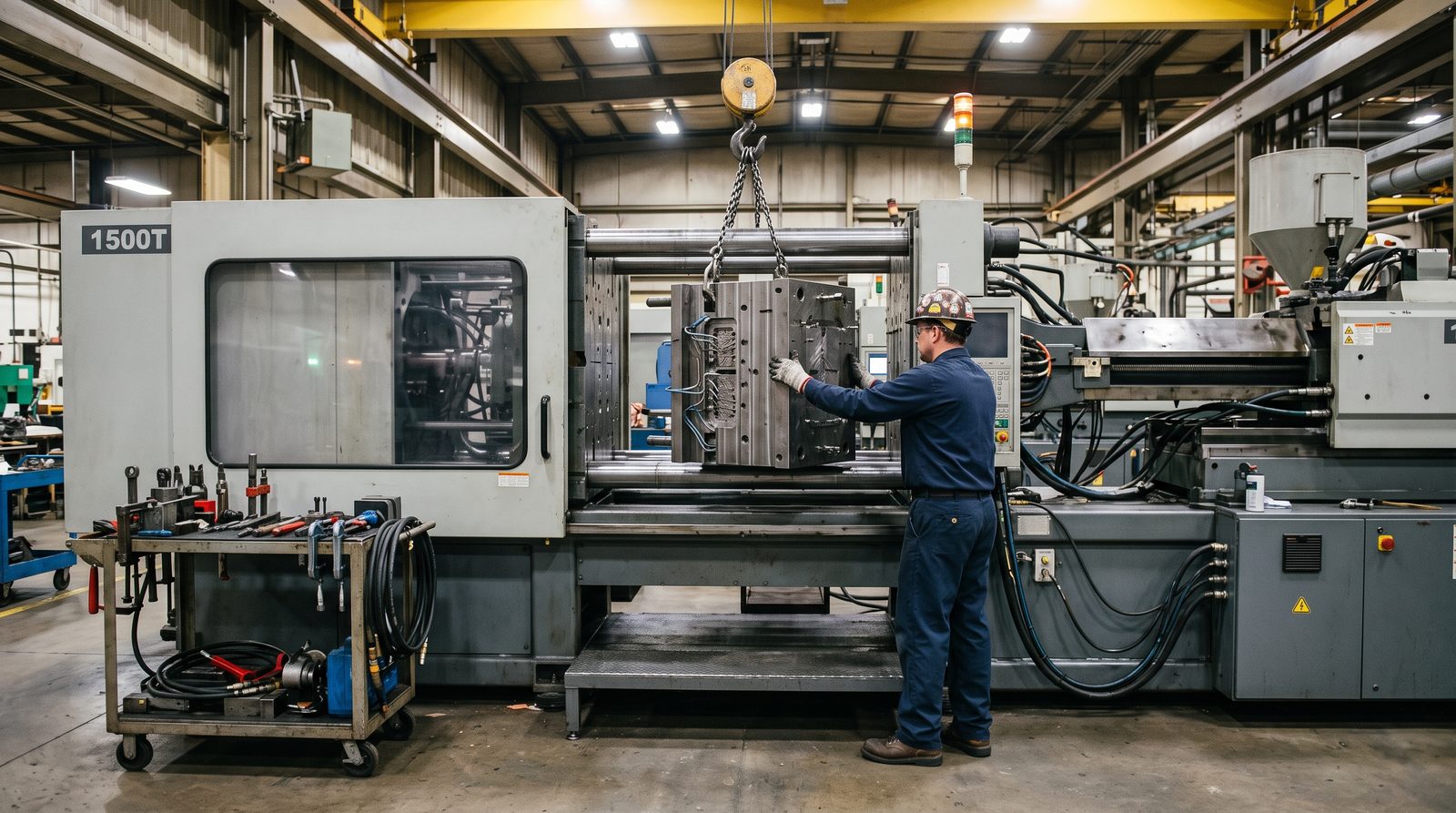
    Changeover is an availability loss. A sensor or app logs when it starts and ends. The camera shows what happened in between: which minutes were waiting, which were fetching and which were the work.

    Generated illustration · example boxes
    A setter guides a steel mold hanging from an overhead crane into an injection molding press, with a tooling cart of clamps and hoses beside the machine
    CAM-02 · Molding cell B · P2Tue 14:31
    Also measuredDie changeTool changeFixture swapLabel and film roll changeFlavor or product changeNozzle changeColor change and purge
    P2 · mold swap, job 4471 to 4480Tuesday, shift 2 · example data
    37 min

      What shorter changeovers are worth on one machine

      Use your own numbers. Illustrative, not a promise.

      45 minBack each production day on this machine
      188 hA year, at 250 production days

      Minutes saved × changeovers a day × 250 days. Freed time becomes output only if the machine is the constraint and there's demand.

      Timed the same way every shiftLast good part to first good part, both visible on camera.
      Work that belongs before the stopFetching tooling, waiting for a setter, hunting for clamps.
      Your best changeover as the standardTrain from the fastest crew's clip for the same job.
      03 · QUALITY LOSS

      Count every good part and every reject, then check the parts themselves

      Most monitoring tools count cycles and leave scrap to a button press. A camera over the outfeed counts good parts and rejects for the quality side of OEE, checks each part for visible defects, and shows what changed when rejects rise.

      Generated illustration · example boxes
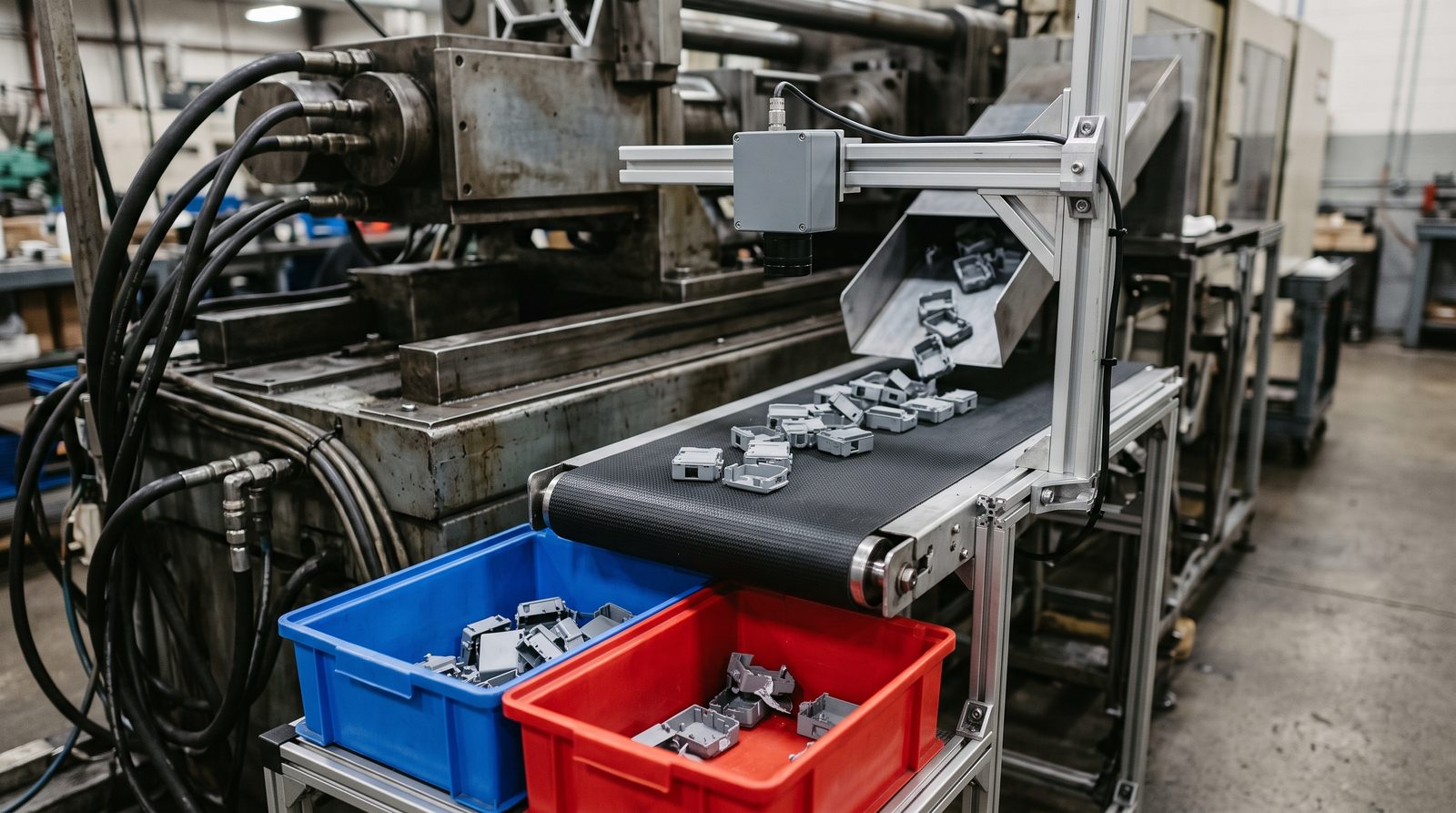
      The outfeed of an injection molding press: parts drop onto a short conveyor under a camera mounted on a bracket, into a blue bin for good parts and a red bin for rejects
      CAM-P4-OUT · P4 outfeed10:35
      Generated illustration · example boxes
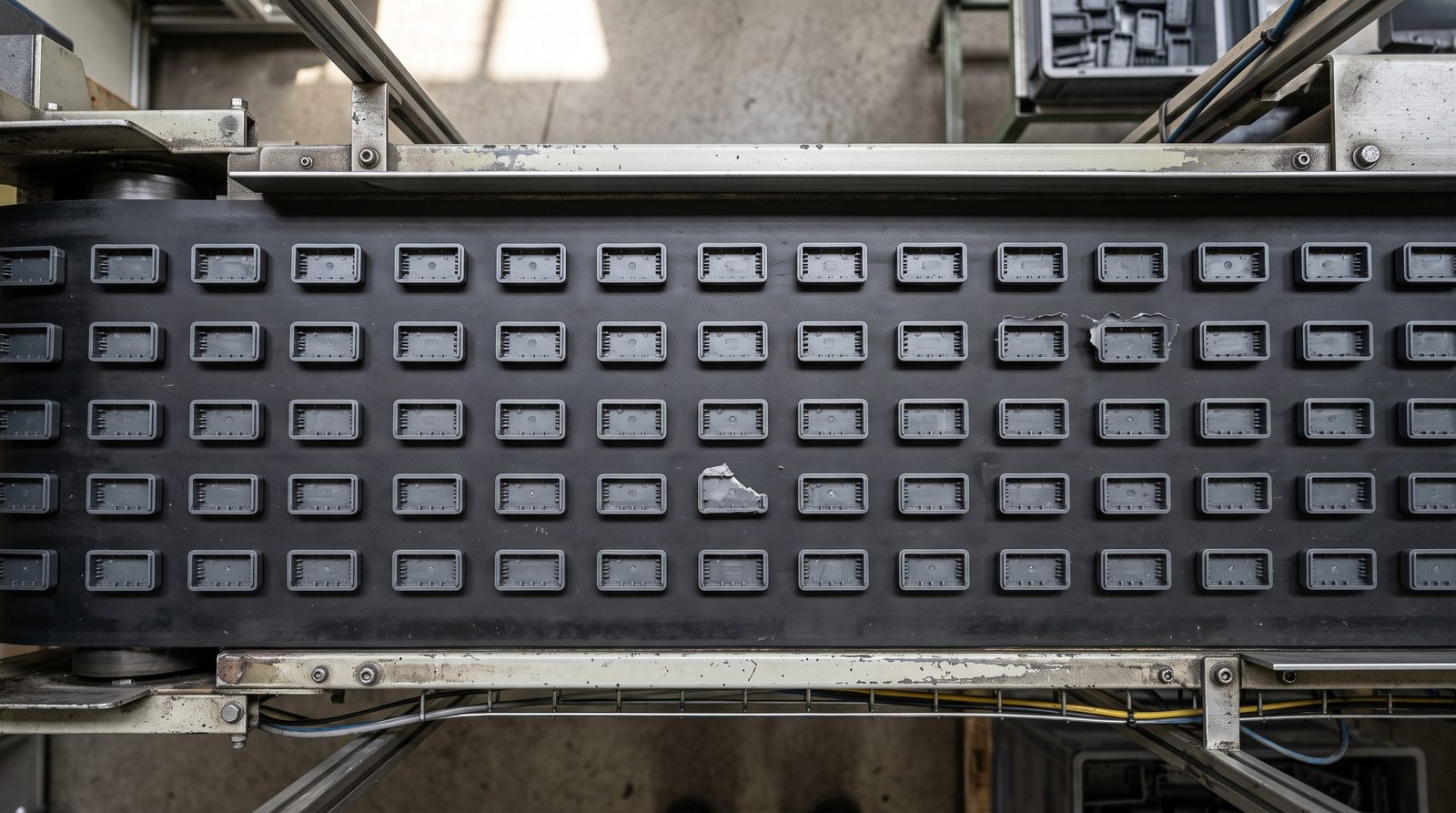
      Rows of molded plastic parts on a conveyor seen from directly above; two parts have ragged flash along an edge and one is missing a corner
      CAM-P4-OUT · frame 10:31:073 flagged · 72 passed
      P4 · shift 1 so far06:00 to 10:35 · example data
      Rejects rising
      1,184Good parts
      23Rejects
      98.1%Quality rate
      Rejects per hour10:00 hour: 10
      What changed before the riseEvents on P4 from the same cameras · example data
        Quality in your OEE, not typed inGood and reject counts by press, job and shift.
        Every part, not a sampleShort shots, flash, missing features, wrong color.
        Traceable to the cycleThe clip of the cycle that made a returned part.

        Part checks need a camera over the outfeed. Reject counts can come from a camera that already sees the bins.

        04 · MACHINE HEALTH

        Older machines with no network port still report

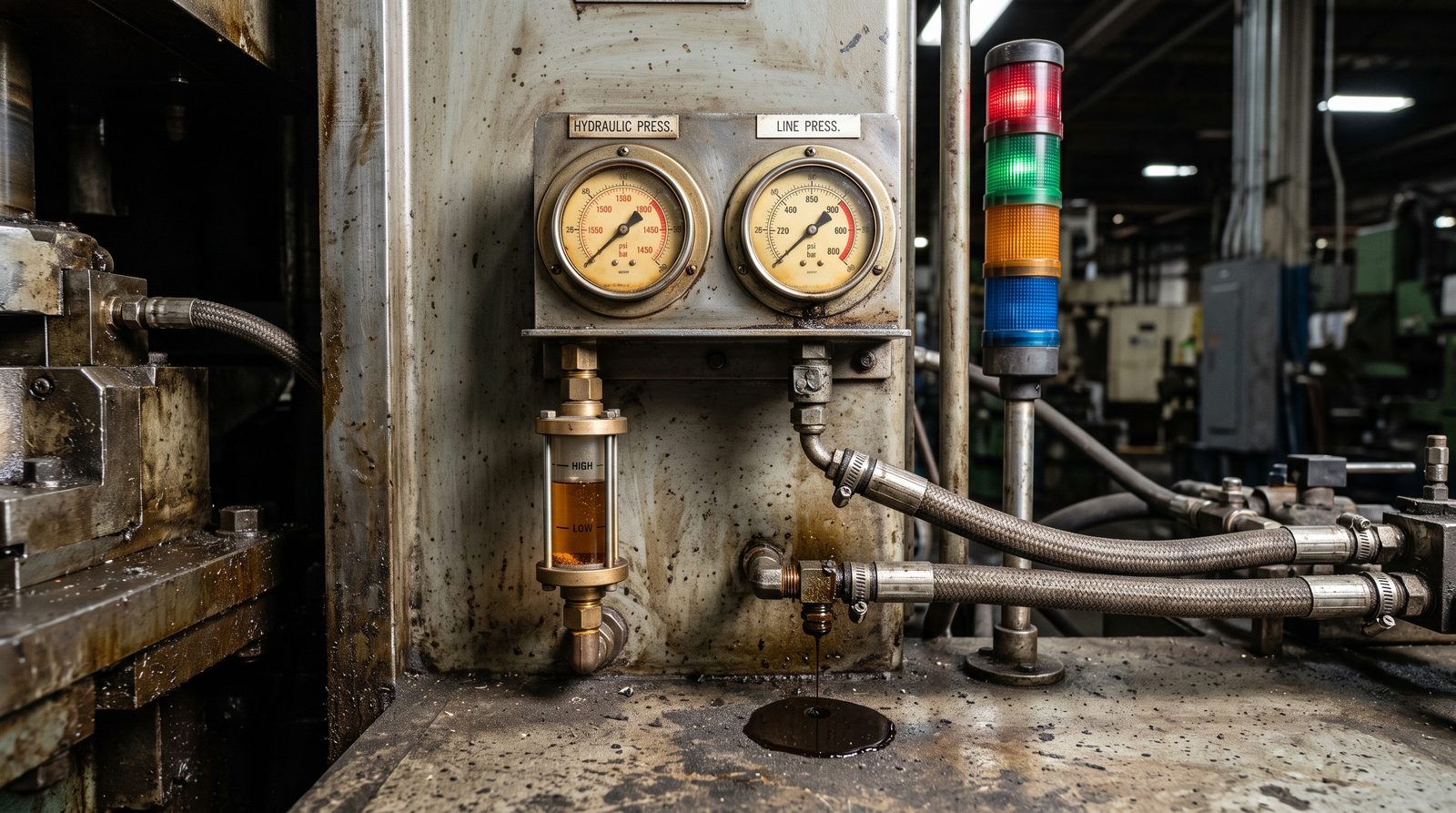
        US manufacturing equipment averages 9 years old by value, and many machines are far older.5 Legacy equipment is manufacturers' top smart-factory roadblock.6 Those machines still have gauges, sight glasses and stack lights. A camera can read them.

        Generated illustration · example boxes
        The side of an older hydraulic press: two analog pressure gauges, an oil sight glass, a stack light and a drip of oil on the floor below a fitting
        CAM-09 · Press shop · hydraulic press H207:45
        Hydraulic press H2No controller connection · example data
        2 to check
          Also visibleCoolant levelChip buildupConveyor slipSmoke or mistGuards open while runningHMI alarm screenProof a PM was doneTime to respond and repair

          Keep the signals you have. Add what they can't see.

          Sensors and controllers count cycles well. They can't explain a stop, break down a changeover or check a part. Agnify fuses their signals with what the camera sees.

          What you needRetrofit sensorsCurrent clamps, cycle sensors, buttonsController or PLC connectionWhere the machine has oneAgnify cameras + signal fusionExisting cameras, plus one where needed
          Run, stop and cycle countsYesCheap and very reliableYesExact, from the controllerYesFrom the scene, or from your signal where one exists
          Why it stoppedOperator inputA button or a reason picked on a terminalPartlyAlarms and program states; not an empty cart or a missing operatorYesNo operator, no material, tool change, jam, maintenance, with the clip
          Inside a changeoverStart and endLogged in an appStart and endFrom program changesEach stepWaiting, fetching, mold out, mold in, first good part
          Part qualityOperator inputScrap entered by handIf wiredReject counts from the machineYesCounted and checked at the outfeed
          Older machines with no networkYesA sensor on each machineNoNeeds a controller to connect toYesStack light, gauges, motion, parts
          Inside an enclosed machineYesNo line of sight neededYesWith fusionCamera on the door, light and outfeed; signal for the inside
          Around the machineNoNoYesMaterial staged, carts, forklifts, operator at the station
          Hardware on each machineA sensor and a battery per signalA connection and gateway per machineNone where a camera already sees it; one camera can cover several machines

          Signal fusion. Where a machine has a PLC output, stack-light tap or cycle sensor, Agnify uses it for exact counts and timing, and the camera for the reason, the changeover steps and the part check.

          50 things a camera can tell you about your equipment

          Each one is scoped in a feasibility study and tested on your footage.

          Start with the cameras you have and add one where a machine needs it

          No sensor on every machine and no controller integration to start. We connect to your existing feeds, add a camera where a view is missing, and bring in machine signals where they help.

          STEP 1

          Connect the views

          RTSP streams, your NVR or recorded footage, mapped to the machines each camera sees.

          STEP 2

          You define the states

          Your team decides which states and stop reasons matter. Agnify's engineers program them and test on your footage before go-live.

          STEP 3

          Run the floor on it

          State timelines by machine and shift, alerts with the frame, reports, and events through the API.

          Cloud by default

          Nothing to host. Results in minutes for dashboards, shift reports and trend alerts.

          Real time on site

          Alerts the moment a machine stops, from a server next to your cameras.

          Signals in, events out

          Machine signals in. States, counts and events out to your MES, BI or spreadsheets.

          See your machines' states before you commit

          A free feasibility study on one cell or line, with an agreed end date.

          1. You send a few hours of footage, or camera accessPick the machines you most want to understand.
          2. We come back with a written resultWhich states and reasons we can see, how reliably, and what the first timeline would show.
          3. If it's useful, we scope a pilot togetherA few machines, live, judged against criteria agreed up front.

          Questions plant teams ask first

          We're looking at sensor-based monitoring. Why cameras?

          Sensors count cycles well, and Agnify can use their signal. They can't tell you why a machine stopped, what happened in a changeover or whether the parts are good. The camera can, and keeps the clip.

          Do we need new cameras?

          Often not for machine states: a camera that sees the machines and their stack lights is usually enough. For part checks we suggest a camera over the outfeed. The feasibility study checks angles and resolution.

          Some of our machines are fully enclosed.

          We watch what's visible (door, stack light, outfeed, operator, material) and fuse a machine signal, such as a PLC output or cycle sensor, for the inside.

          How do you handle privacy and our workforce?

          Reports are by machine, role and shift, never by person. No facial recognition, whole-person blur on request, short retention, and video can stay on a server in your building. We help you brief your teams and any works council or union.

          Can it alert us the moment a machine stops?

          Yes, from a server on site. Dashboards and reports run in the cloud within minutes. Agnify isn't a certified safety system and doesn't replace machine guarding.

          How do we know it's accurate on our machines?

          We measure it on your footage, against stops, changeovers and rejects your team checks by hand, before anything scales.

          What does it take from our IT team?

          Camera streams or an NVR export, and a network path out. A server on site if you need real time or video must stay in the building.

          Tell us about your machines

          Tell us what you run and what you want to know. We'll reply within one business day.

          • Free, time bound and no commitment
          • Works from a few hours of footage or a camera stream
          • Or email info@agnify.ai